Help Center
Getting Up to Speed
Most traders fail because they believe the market can be controlled, engineered, or forced into predictable outcomes. In reality, however, market movement is random about 50% of the time and not driven by any strong catalyst. Consistent success in the market comes from having the experience and skill to discern when conditions are favorable, the discipline to wait for the picture to “become clear” and the tools to control your risk when that picture emerges.
MTPredictor—which stands for Market Turn Predictor—was built on the premise that identifying high-probability turning points that present asymmetric trading opportunities is the foundation of consistent, professional trading.
The Foundation: Elliott Wave Theory
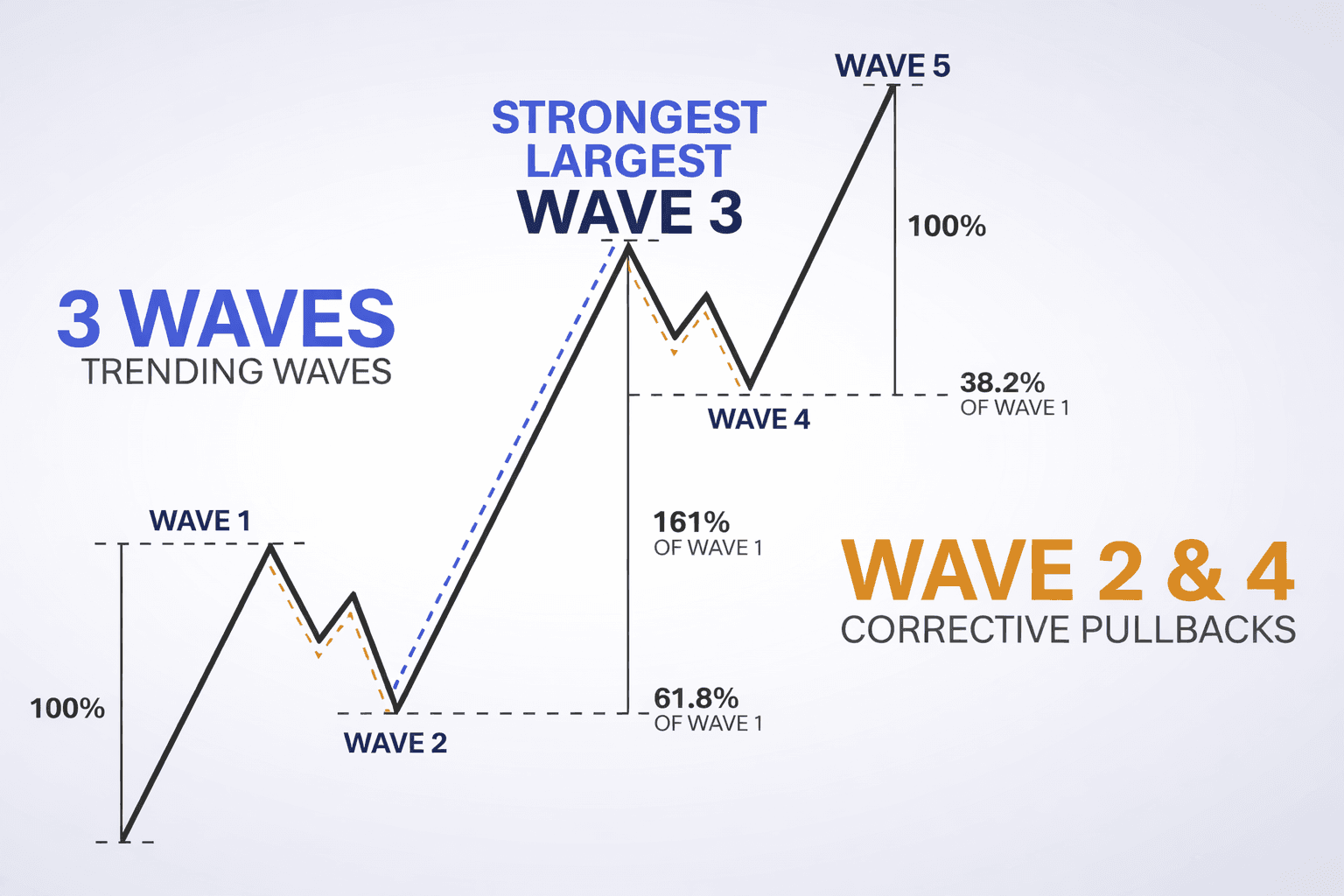
To understand how MTPredictor finds these turns, it helps to understand the background of Elliott Wave Theory. Developed by Ralph Nelson Elliott in the 1930s, the theory posits that markets move in repetitive cycles (waves) driven by investor psychology.
- The Basic Pattern: A full impulsive cycle consists of a 5-wave move in the direction of the main trend.
- Impulse Waves:Within this 5-wave sequence, there are three "impulse" waves (1, 3, and 5). These are the strong, motive moves that drive the market forward in the direction of the primary trend.
- Corrective Waves: These impulse waves are separated by two corrective 3-wave "ABC" moves (waves 2 and 4). These are temporary "breathers" or pullbacks that go against the main trend before the next impulse wave begins.
Traditional Elliott Wave analysis is difficult because analysts try to force a "count" on the chart at all times. IN order to overcome these limitations while taking advantage of the strengths of Elliott Wave, we developed the unique Isolation Approach. With our approach, we don't try to label every wiggle. Instead, we look at swings in isolation. We only apply Elliott Wave logic when the market presents a clear and objective pattern or reaches a major structural extreme, allowing us to identify the start of a new Wave 1 impulse, the end of a corrective ABC pattern or a 5-Wave trend with high precision.
The Core Strategy: Trading the Extremes
Market patterns can generally be classified as being at Extremes or in the Middle.
- The Middle: Choppy, noisy, and difficult to trade.
- The Extremes: Key swing highs and lows where the market is far more predictable. At these points, price will either reverse or continue its trend, making them the highest-probability areas for trade setups.
MTPredictor identifies these extreme zones using our proprietary Decision Points (DPs). These are leading (not lagging) levels that project potential turning points in advance, before the market reaches them.
Why DPs Matter: Turning Points & New Trends
When the market reaches and respects a higher time frame DP, the random “middle” behavior ends and a new move—often a new Elliott Wave sequence—begins. Once the market respects a DP, we can treat that point as the start of a new structured move giving you the edge to trade either the reversal or the new trend.
The Two-Step Process
Step 1: The “Where” (Higher Time Frame)
Use DPs on a higher time frame to identify where major swings are likely to begin.
- The Filter: If the market is not at a DP, it’s probably trading in the “middle” and should be avoided until a new DP is respected and establishes a clear trend direction.
- The Trigger: If the market hits and respects a DP and forms an Elliott Wave ABC correction, a new move/Wave 1 often begins.
Step 2: The “How” (Trading Time Frame)
Once price reverses at a DP—or clearly begins trending away from one—move to your shorter time frame to execute.
- Automatic setups like TS1, TS2, TS3, TS4, VS, PB identify precise entry patterns.
- MTPredictor calculates your Entry, Stop, and Position Size automatically.
From Setup to Results: Your 4-Step Workflow
- Identify the Zone: Place DPs on your higher time frame chart to see where new moves are likely to begin.
- Confirm the Signal: On your trading time frame, look for an automatic MTPredictor setup (Blue for Buy, Red for Sell) that aligns with the DP reversal or new trend.
- Manage the Risk: Select the setup to view the Risk/Reward analysis. MTPredictor automatically sizes your trade, so your risk remains consistent and small. Aim for a minimum 2:1 Reward/Risk ratio.
- Exit with Confidence: As price moves toward the Wave Price Targets (WPTs), use the MTP Trend to decide whether to bank profits early or use the ATR Stopto capture "Power Profits."
Summary: The Professional Edge
MTPredictor moves you away from "forecasting" and into a business-like process. By using DPs to find the turning points and Position Sizing to control your risk, you put the math of successful trading on your side.
See the process in action with this short video:
- Example using the Standalone version ( 12 mins )
- Example using the NinjaTrader 8 add-ons ( 12 mins )
- Example using the TradingView Scripts (6 mins )
Note:
While MTPredictor provides automatic setups, they should not be followed blindly. Traders must use judgment, especially in relation to the larger trend, and take responsibility for ensuring each trade fits their own analysis and trading plan. Trading involves risk, so always practice in a SIM account until you are comfortable with both the software and your strategy.