Elliott Wave Rules and General Observations
Elliott Wave Rules and Guidelines
There are three main rules that most standard Elliott Wave analysts adhere to today:
Elliott Wave 2 Rules
Elliott Wave (2) cannot retrace past the start of Wave (1)
If Wave 2 retraces past the start of Wave 1, then it cannot be considered a Wave 2 and the current wave structure must be reconsidered.
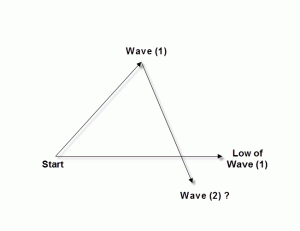
This cannot be considered a valid wave count, because Wave (2) has traded below the start of Wave (1), so this wave count must be re-considered.
Elliott Wave 3 Rules
Elliott Wave (3) cannot be the shortest Impulsive wave
Wave 3 cannot be the shortest Impulsive wave in a completed 5-wave structure.
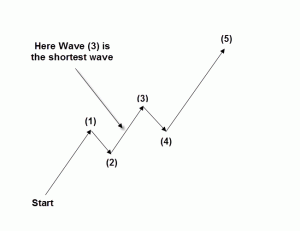
Here Wave 3 is the shortest Impulsive wave in this completed 5-wave sequence, which would be in breach of this second rule, so this wave count is incorrect and must be re-considered.
Elliott Wave 4 Rules
Elliott Wave (4) cannot retrace into the area of Wave (1)
If Wave 4 retraces into the area of Wave 1, then it cannot be considered a Wave 4, and the current wave structure must be reconsidered.
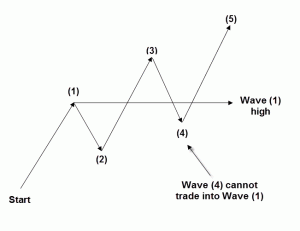
Here Wave 4 has retraced back below the high of Wave 1, which would be in breach of the third rule, so this wave count is incorrect and must be re-considered.
Note: In real life this “Rule” can be breached slightly, please see Elliott Wave 4 Observations section
Although these are quoted as rules, Elliott himself (in his original writings) never referred to these as strict rules, he used phrases like should and rarely to describe them. As such, the label of Elliott wave rules was probably added in later years in an attempt to make the principle less ambiguous and more structured and exact.
Elliott Wave 4 Observations
Elliott Wave (4) can retrace into the area of Wave (1) (slightly)
Rule number 3 states that Wave (4) cannot retrace into the area of Wave (1).
However, in practice, particularly in the commodity markets, a small retracement into the area of Wave (1) often happens.
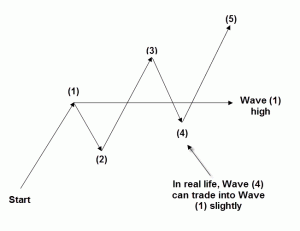
Here Wave (4) has retraced back just below the high of Wave (1), which normally would invalidate this as a potential 5-wave count. However, in practice you can allow Wave (4) to dip into the area of wave (1) slightly.
Actually, if the market in question immediately reverses and then moves out of the area of Wave (1), then this should be allowed as a valid 5 wave count. As you will see later, although this minor breach of the Wave (1) extreme can be allowed it should not normally happen in a perfect 5-wave count.
As such, when this happens you should treat the wave count as valid but not perfect.
General Observations
The section above outlined the three main Elliott Wave rules that should be obeyed in all 5-wave sequences. Now we would like to look at some additional observations and general guidelines that can help in placing an Elliott Wave count on a chart.
Corrections and corrective waves do not have a set of rules associated with them, so these general observations focus on the ideal 5 wave pattern.
Elliott Wave 3 Observations
Elliott Wave (3) is usually the strongest wave.
Elliott Wave rule no:2 stated that Wave (3) cannot be the shortest wave in a complete 5 wave sequence. In practice, Wave (3) is usually the strongest and longest wave. As wave (3) is usually the longest and strongest wave it normally carries the largest profit potential.
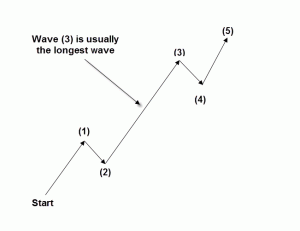
Wave (3) very often is the extended wave, where this swing trades beyond what is considered normal in a completed 5-wave sequence. Again this makes this an ideal wave to trade, because of its large profit potential.
Elliott Wave (1) and (5)
Elliott Wave (1) and Elliott Wave (5) are very often equal in Price.
If Wave (3) is the extended wave (i.e. it is the longest Wave) then very often Wave (1) and Wave (5) tend to be approximately equal in price.
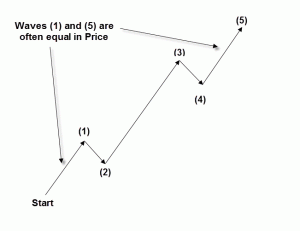
As wave (5) is very often equal in price to Wave (1), once Wave (4) is complete, this allows an easy way to approximate where the Wave (5) will end.
The rule of Alternation
The rule of Alternation There is a general tendency for the pattern of the two corrective swings in a completed 5-wave sequence to alternate between a simple (very often an ABC) correction and one of the more complicated or complex Elliott corrections.
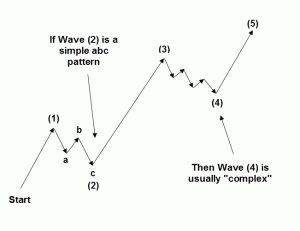
This is a very helpful observation, because if Wave 2 unfolds as a simple ABC correction then probability will suggest that Wave 4 is more likely to unfold as a more complex correction. And vice-versa, if Wave 2 is complex, then you should anticipate that wave 4 is likely to unfold as a simple ABC pattern.
Elliott Wave 2 Observations
Elliott Wave (2) generally unfolds as a simple abc correction
In most cases Wave (2) usually unfolds as a simple ABC correction. Or put another way, a simple ABC correction is found in a Wave (2) correction more often than in a Wave (4).
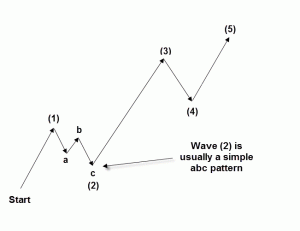
Again, this is a very useful piece of information, because once Wave (1) is complete, then the most likely pattern to unfold is a simple ABC correction.
And, because of the rule of alternation, this leads onto Wave (4) usually being the complex correction in a completed 5-wave sequence.
Elliott Wave 5 Complete
Once an Elliott Wave (5) is complete, the whole sequence is corrected.
Once the Wave 5 of a completed 5-wave sequence is complete a correction will unfold that corrects the entire prior 5-wave sequence.
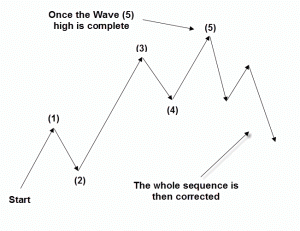
What this means in practice is that once Wave 5 is complete a correction which is larger than any correction incurred during the prior 5-wave sequence should then unfold.
The Initial Swing
The initial swing off a completed 5 wave sequence will often find support/resistance in the area of the prior minor Wave (4).
Again, this is a very useful observation as it gives you an approximate target for the first swing of the correction following the end of a completed 5-wave sequence. In Elliott wave terms this is the Wave (1orA).
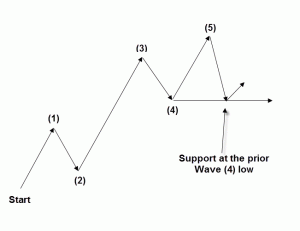
Here you can see how the first swing off the Wave (5) high found support “in the area of” the price level of the prior minor Wave (4). In practice this area is usually slightly exceeded, and support is found just beyond this prior Wave (4) level, this is usually at the Decision Point (DP) level form the prior Wave (4).
Correction is Complete
Once a correction is complete, the main trend resumes.
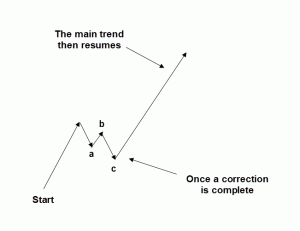
Again, this is a very important observation, because it allows you to anticipate that once a corrective sequence (ideally a simple abc) is complete, it should be followed by a strong and impulsive move in the original trend direction.
Elliott Wave 4 observation
Elliott Wave (4) can retrace into the area of Wave (1) (slightly)
Rule number 3 states that Wave (4) cannot retrace into the area of Wave (1). However, in practice, particularly in the commodity markets, a small retracement into the area of Wave (1) often happens.
Here Wave (4) has retraced back just below the high of Wave (1), which normally would invalidate this as a potential 5-wave count. However, in practice you can allow Wave (4) to dip into the area of wave (1) slightly.
Actually, if the market in question immediately reverses and then moves out of the area of Wave (1), then this should be allowed as a valid 5 wave count. As you will see later, although this minor breach of the Wave (1) extreme can be allowed it should not normally happen in a perfect 5-wave count.
As such, when this happens you should treat the wave count as valid but not perfect.
Now we have finished the specific Elliott Wave rules and also some General Observations, you should be ready to apply these to some charts. But before you do, we suggest taking a look at the next section on how to trade Elliott Wave, especially as this outlines how Elliott Wave patterns unfold in today’s markets, and as such, how they are best traded.